 Verdant stock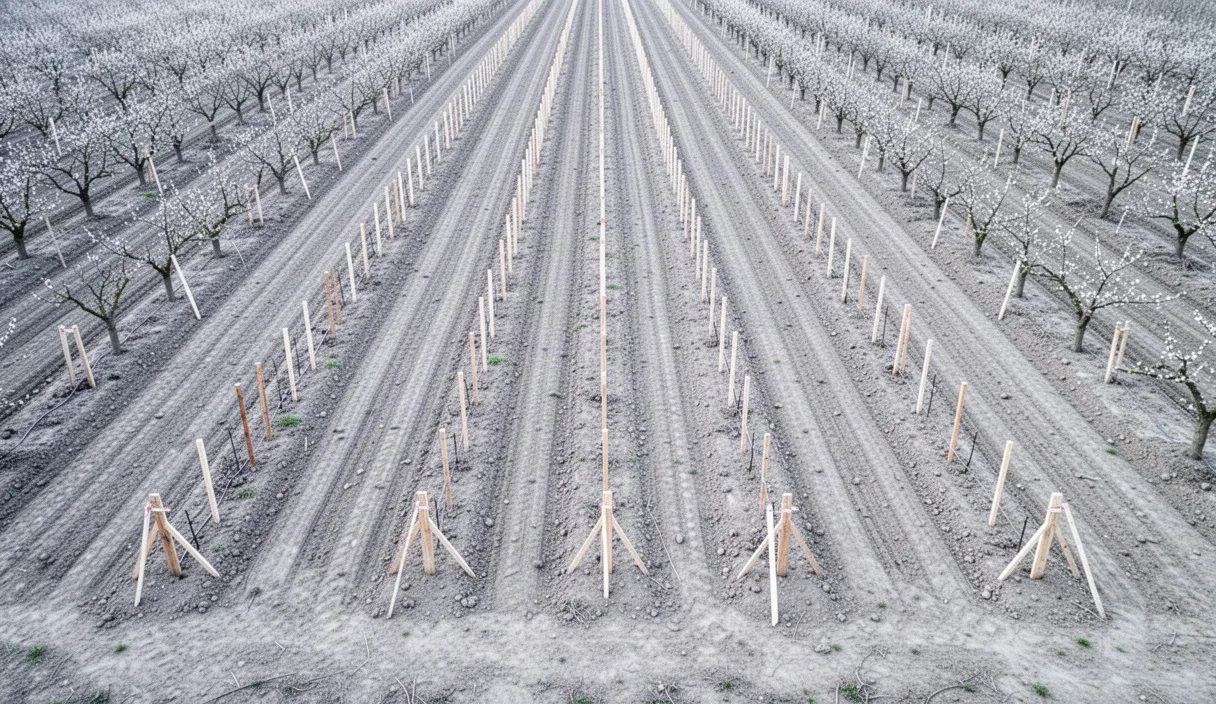

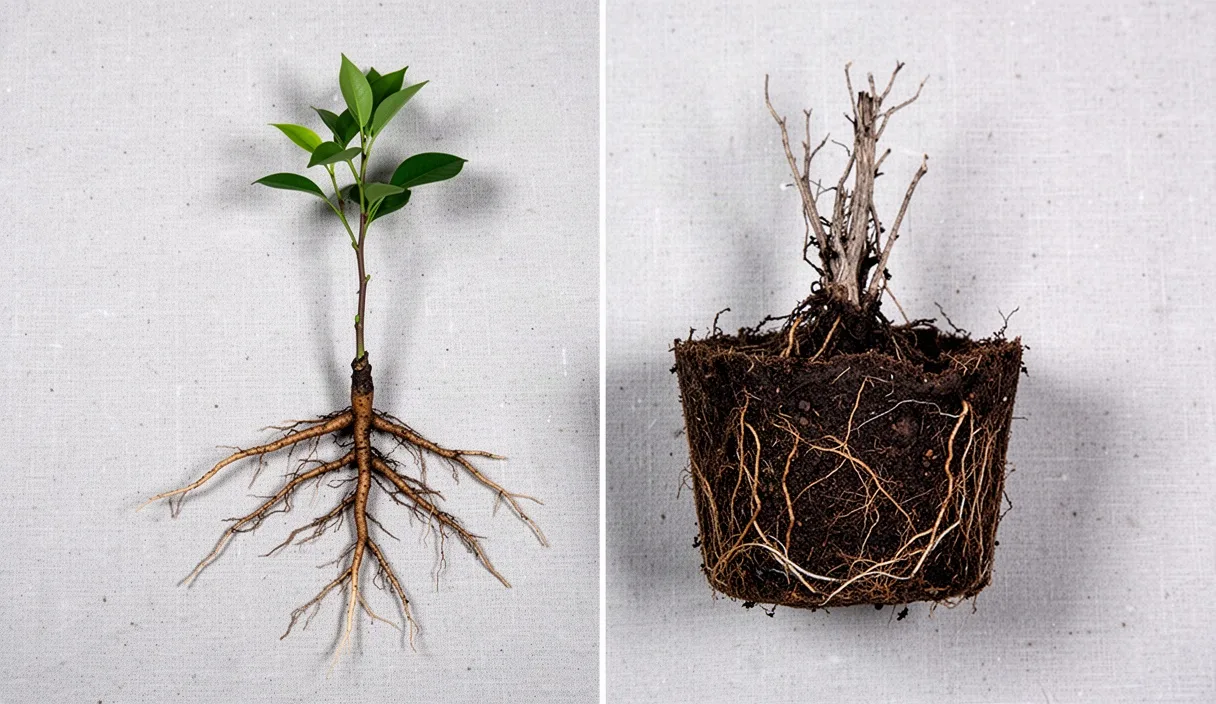
Seedling-root orchards rely on rootstocks grown directly from seed rather than vegetatively propagated, clonal root systems. In species such as standard apple (Malus domestica), European pear (Pyrus communis), sweet cherry (Prunus avium), and Persian walnut (Juglans regia), ungrafted or seedling rootstocks yield full-sized, vigorous standard trees. Unlike high-density blocks trained on dwarfing stocks, standard seedling trees develop extensive root architecture, live for several decades, and produce large branch frameworks that demand substantial physical space. Correct spacing decisions made during site planning remain unalterable once the orchard establishes its permanent root system.
Establishing an orchard on seedling rootstocks requires an extended planning horizon. Standard trees can take seven to twelve years to reach commercial cropping and fifteen to twenty-five years to reach their full canopy volume. If trees are planted too closely, mutual shading thins out lower fruiting wood, traps humidity, and obstructs the passage of tractors and sprayers. Conversely, spacing trees too far apart results in unproductive land area and lower yields per acre during the first two decades of the orchard life cycle. Precise layout design balances mature canopy limits with working row access.
Canopy Diameter Projections for Ungrafted Seedling Stocks
Seedling rootstocks retain their wild, unimpeded genetic vigor. Because each seedling has unique parentage, canopy spread exhibits natural variation even within a single cultivar block. Field managers must calculate spacing based on the upper tier of projected vegetative growth rather than average nursery catalog estimates. Soil fertility, available rooting depth, and regional annual precipitation directly modify these dimensions.
On deep, well-drained alluvial loams, ungrafted standard apple trees regularly produce canopies measuring 26 to 32 feet across at maturity. Sweet cherries on Prunus avium (Mazzard) seedling stocks reach spreads between 28 and 34 feet if left unpruned to a natural vase or central leader. European pears on seedling rootstocks develop narrower, more upright forms, typically achieving a diameter of 20 to 24 feet, while standard walnuts require the largest footprint, frequently exceeding 42 feet in mature radial width. Restrictive soils, such as clay pans or shallow rocky profiles, limit taproot extension and can reduce canopy diameter by 12 to 18 percent.
| Species and Stock | Standard Soil Spread (ft) | Deep Alluvial Spread (ft) | Target In-Row Distance (ft) |
|---|---|---|---|
| Apple on Seedling | 24 to 28 | 28 to 32 | 26 to 30 |
| Pear on Seedling | 18 to 22 | 22 to 26 | 20 to 24 |
| Sweet Cherry on Mazzard | 26 to 30 | 30 to 35 | 28 to 32 |
| Walnut on Paradox / Seedling | 38 to 44 | 44 to 52 | 40 to 48 |
When selecting in-row spacing, allocate sufficient room so that mature branch tips remain at least two feet clear of neighboring trees after dormant pruning. Interlocking canopies cause interior branch dieback through light starvation, which eliminates fruit-bearing spurs and forces fruit production entirely to the upper perimeter of the tree canopy.
Row Orientation for Optimal Sunlight Distribution
Row orientation determines the quantity and uniformity of photosynthetically active radiation (PAR) absorbed by the tree canopy throughout the growing season. For seedling-root blocks located between latitudes 34 degrees and 48 degrees north, a true north-to-south row orientation provides the most uniform illumination on both the east and west canopies over a 24-hour cycle.
In north-to-south arrangements, morning solar radiation strikes the eastern canopy profile, warms wet foliage to reduce pathogen germination periods, and drives photosynthesis during the hours of optimal stomatal conductance. As the sun reaches its zenith, the upper canopy receives peak irradiance, while afternoon light falls across the western face. Rows oriented east-to-west suffer from systemic light asymmetry. The southern side of an east-to-west row receives intense, continuous light that can cause bark scald and fruit sunburn, while the northern face remains largely in shaded ambient light, leading to poor color development and reduced blossom bud induction.
Topography and wind profiles require occasional deviations from a true north-to-south baseline. If prevailing summer winds exceed 18 miles per hour on an exposed plain, aligning rows parallel to the wind direction minimizes limb breakage, structural lean, and spray drift during chemical applications. If a field site presents a uniform slope, row orientation must often follow the contour rather than solar coordinates to prevent run-off channels and equipment rollover risks.
Machinery Turnaround Clearance on Field Headlands
Headlands are the unplanted access buffers located at both ends of the tree rows. They must accommodate the full turning radius of the largest machinery combinations deployed in the orchard, including utility tractors hitched to trailing air-blast sprayers, bulk bin trailers, or flail mowers. Undersized headlands force operators to make multi-point turns, which leads to soil compaction, gouged wheel ruts, damaged end trees, and sheared irrigation risers.
A standard 75-horsepower four-wheel-drive orchard tractor pulling a 500-gallon tandem-axle air-blast sprayer requires an unobstructed turning diameter of 26 to 30 feet to complete a smooth, continuous turn into an adjacent or alternate row. If the turn involves pulling into the immediately adjacent row, an extra turning loop is necessary. For this machinery scale, a minimum headland width of 32 feet between the outermost tree trunk and the boundary fence, ditch, or windbreak is required. For operations using larger 100-horsepower tractors or long mechanical harvest trains, widen the headland to 36 or 40 feet.
- Compact utility tractor with mounted mower: 22 to 24 feet minimum headland depth.
- Mid-size orchard tractor with 400-gallon trailing sprayer: 28 to 30 feet minimum headland depth.
- Standard orchard tractor with 500-to-800-gallon trailing sprayer: 32 to 36 feet minimum headland depth.
- Bin trailers and dual-axle harvest transport rigs: 36 to 42 feet minimum headland depth.
Include drainage infrastructure and underground mainline valves within the headland perimeter layout. Never plant end trees where equipment tracks will regularly run over the structural root zones, as seedling taproots and lateral anchor roots are vulnerable to deep soil compaction within the top 18 inches of soil.
Calculations for Acres Versus Total Tree Quantities
Calculating the correct number of trees per acre requires separating the gross parcel acreage from the net plantable area. The gross acreage includes access tracks, drainage swales, windbreaks, building pads, and headlands. Calculating planting density using total acreage figures causes growers to over-order nursery stock, creating surplus trees that must either be heeled in or discarded.
One statute acre contains 43,560 square feet. In a traditional rectangular grid, the theoretical tree count per plantable acre is calculated with the following standard formula:
Trees Per Acre = 43,560 / (In-Row Spacing in Feet * Between-Row Spacing in Feet)
Apply this formula through a practical calculation sequence:
- Measure the gross field boundaries using GPS survey equipment or accurate boundary maps.
- Deduct the square footage of the perimeter headlands and boundary roads. For example, a 10-acre square field measuring 660 feet by 660 feet with a 35-foot headland on all four edges loses 87,500 square feet of plantable space, leaving 348,100 square feet (approximately 7.99 net acres).
- Determine working row spacing by taking projected canopy width and adding equipment clearance. For standard apples with an expected 26-foot canopy spread, allow an 8-foot drive alley: row width equals 34 feet, and in-row tree spacing equals 26 feet.
- Multiply the in-row spacing by the row width (26 * 34 = 884 square feet per tree).
- Divide the net square footage by the area per tree (348,100 / 884 = 393.7 trees).
For this example parcel, order exactly 394 trees for full establishment, plus an additional 3 to 5 percent to hold in a nursery row for early-stage replantings due to establishment mortality.
Adjusting Layouts for Slopes Exceeding Five Degrees
Land slopes exceeding five degrees (an 8.7 percent grade) introduce gravity-driven complications for irrigation uniformity, tractor safety, and topsoil preservation. Planting an open grid down the fall line on slopes between 5 and 12 degrees creates vertical wheel paths that quickly become erosion gullies during seasonal rain events. Beyond eight degrees, high-profile equipment such as loaded air-blast sprayers become susceptible to tipping when operated across the grade.
On continuous grades between five and eight degrees, run rows on the contour rather than strictly along a north-to-south orientation. Contour rows follow horizontal elevation lines across the landscape. The spacing between individual contour rows will vary as the slope steepens or flattens across the field face. When setting contour stakes, maintain the specified minimum row width at the narrowest point of the curve to ensure machinery does not become pinched between mature tree canopies.
Where the slope gradient ranges from 8 to 14 degrees, install cross-slope terraces or bench cuts. Terracing requires expanding the nominal row width by 4 to 8 feet to account for the unplantable cut-and-fill slopes of each bench. In regions prone to early autumn or late spring frosts, keep rows aligned with the natural downward slope whenever possible to facilitate cold air drainage. If contour rows are required on frost-susceptible hillsides, leave intermittent gaps every 150 to 200 feet along the lower vegetative lines to prevent cold air from pooling into localized frost pockets behind dense tree rows.
Common Mistakes
- Planning based on initial sapling size: Spacing trees based on how they appear during the first five years leads to severe over-planting. Plan the spacing strictly for the mature frame expected at year twenty.
- Ignoring trailing sprayer drift zones: Failing to include minimum row-to-row clearances for spray fans results in heavy chemical scorch on lower fruit branches and blocks light penetration into the alley floor.
- Under-allocating headland depth: Setting end trees too close to fences or irrigation ditches prevents smooth continuous equipment turns and leads to broken limbs and damaged root zones.
- Assuming nursery catalog vigor applies universally: Failing to adjust for localized soil depth and native vigor causes trees on deep, rich soils to outgrow their allotted spaces.
- Planting down the fall line on steep terrain: Running drive rows directly down slopes exceeding five degrees encourages heavy water erosion along wheel paths.
Practical Next Steps
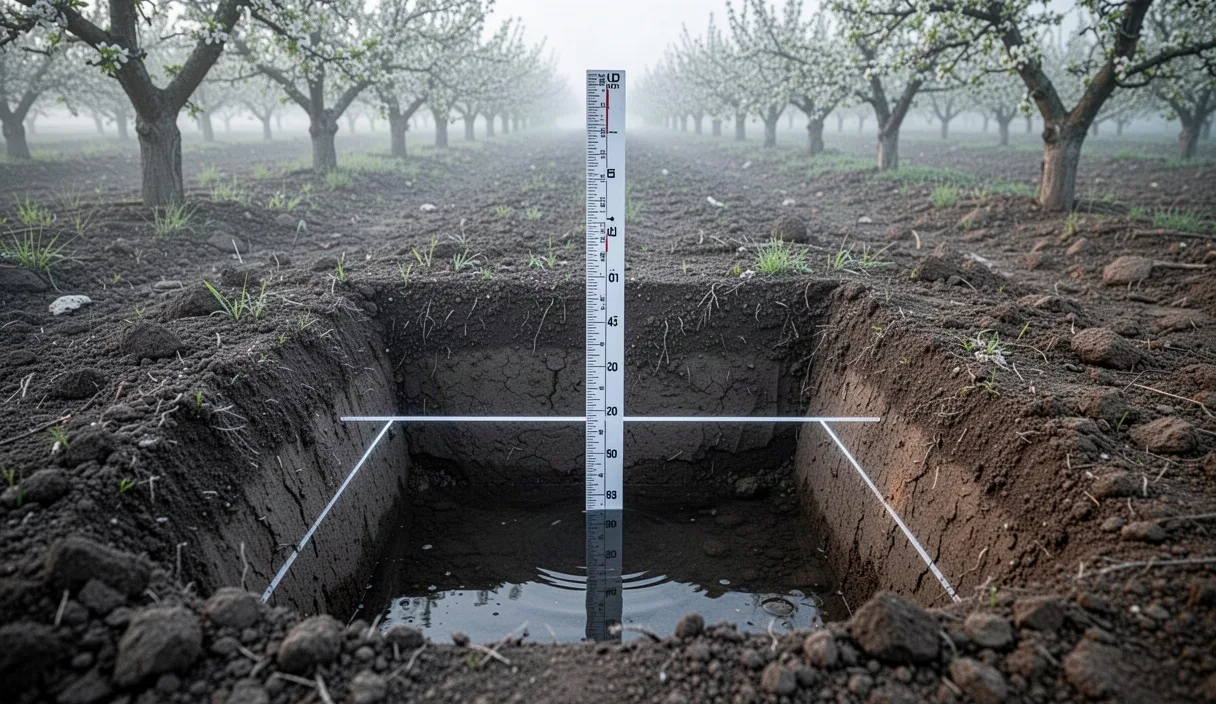
To begin layout planning on a seedling-root orchard, collect five composite soil cores across the parcel to evaluate depth, texture, and subsoil layers. Confirm with your local soil conservation service or cooperative extension whether the soil profile contains restrictive hardpans that could modify standard canopy dimensions.
Next, acquire the exact dimensions of your operations machinery. Measure the width of your widest mower and the turning radius of your primary orchard tractor while hitched to a full spray rig. Use these verified physical metrics rather than theoretical manual figures to establish the baseline for drive row widths and headland depths.
Stake the outer boundary lines and establish clear markers for your headland turning corridors before placing individual tree flags. On parcels featuring complex terrain, consult a certified agricultural surveyor or an experienced conservation engineer to shoot accurate contour lines. Procure stock orders well in advance, adjusting counts to net plantable acreage rather than gross parcel size.